

About the artist
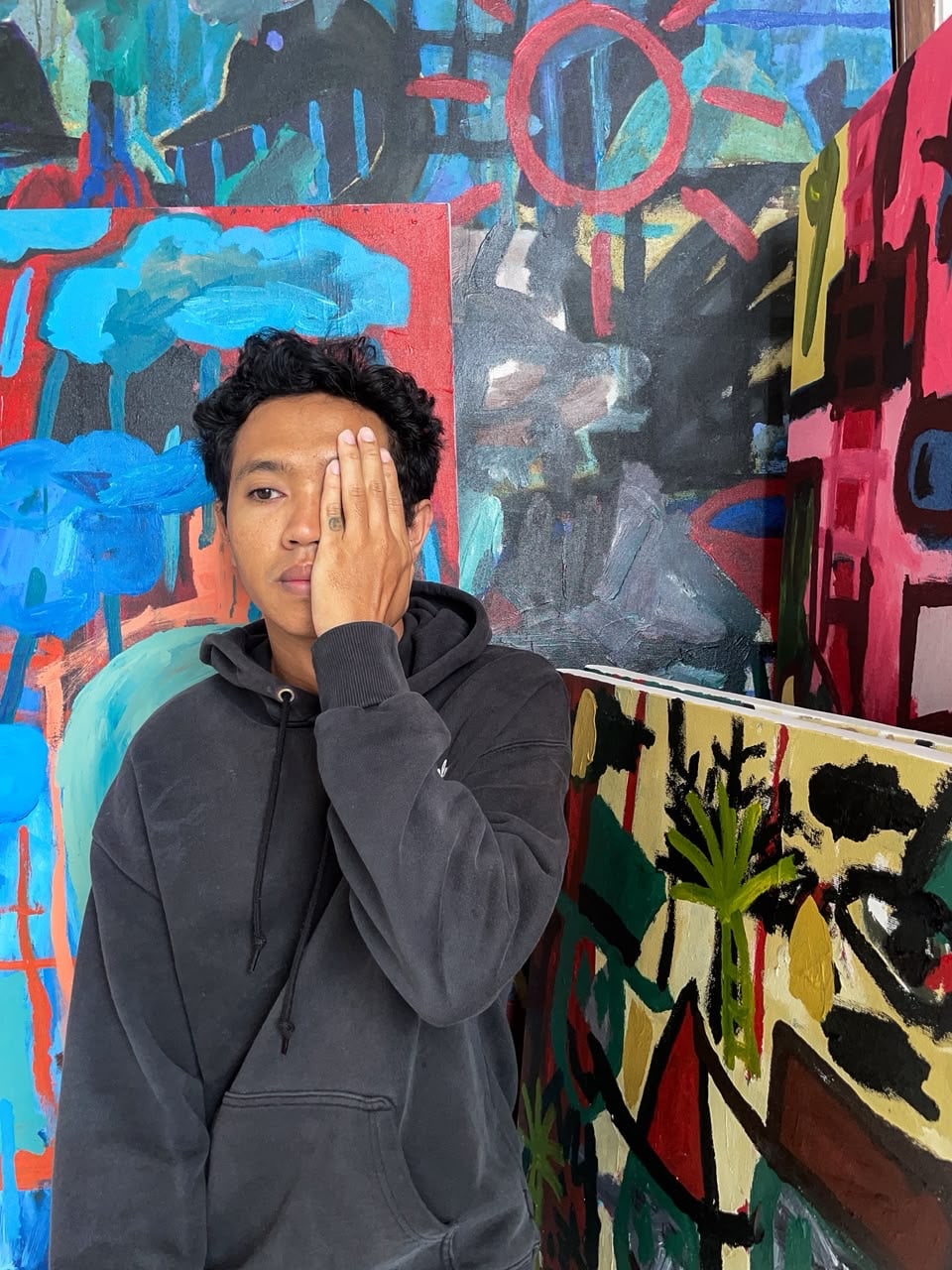
Rizal Fathoni, known as Toni (b. Surabaya, 1998), is an artist whose practice emerges from memory, personal experience, anxieties, and the pleasures found within everyday life. Born and raised in Surabaya during a period marked by Indonesia's economic crisis in the late 1990s, his early life became part of a personal landscape of memory that continues to inform the way he perceives life and approaches his artistic practice.
Toni's relationship with art began in childhood. From kindergarten, he was already actively involved in art activities and competitions, gradually developing an intuitive relationship with image-making and visual expression. His artistic sensibility was also deeply influenced by his father, an architect with a strong ability to draw. Through this relationship, art was introduced to Toni not merely as an activity, but as a way of seeing, observing, and understanding the world.
In his practice, Toni often finds himself working through what might be described as a process of memory. His works emerge from accumulated experiences, personal anxieties, moments of pleasure, and seemingly ordinary encounters that leave traces within him. As a result, his works can shift between the playful and the contemplative, between spontaneity and seriousness, and at times between intimacy and confrontation.
Play is an essential part of Toni's creative process. Within his works, he allows himself the freedom to play without having to fully control the outcome. This play can become a form of protest, a reminder, an escape, or simply a way of engaging with things that cannot always be articulated through language. For Toni, seriousness does not necessarily require rigidity. Instead, it can coexist with intuition, freedom, humor, and experimentation.
The making of each work follows its own rhythm. Some works emerge almost instinctively and within a short period of time, while others demand a longer process of repetition, reconsideration, and revision. Rather than imposing a fixed methodology, Toni allows each work to determine its own pace and direction.
At the core of his practice is a commitment to honesty. Toni does not seek to disguise what lies behind each work. For him, making art is inherently difficult because a work is never simply an image or an object; it carries a part of the artist himself. Each piece becomes a personal record of what he has experienced, questioned, remembered, enjoyed, resisted, and perhaps failed to fully understand.
Ultimately, Toni's practice is an on going attempt to understand himself through art. He does not regard artistic practice as a destination or a finished achievement, but as a continuous process of questioning, refining, and discovering new possibilities. To make art, for Toni, is to remain willing to confront oneself and to keep trying to make something more honest each day.
8 pieces, in the order you will walk past them. Take your time.
Explore this exhibit through your five senses
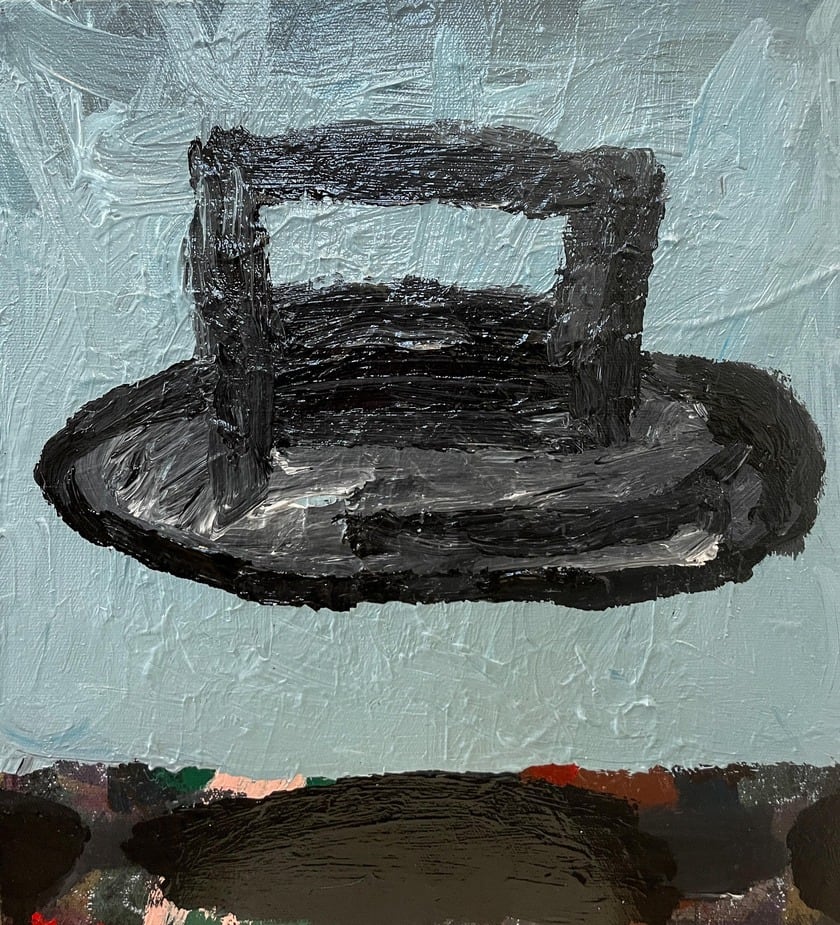
Reminds Me Of
This work begins with an imagined vision of the American cowboy era — a period often represented through ideas of freedom, courage, and the romanticism of the frontier. Yet beneath this narrative lies a history of power, exploitation, dispossession, and human bodies placed in conditions of labour, submission, and survival.
Through the figure of the cowboy and symbols associated with slavery, the work draws a connection to the dynamics of power within the Indonesian government. This is not intended to equate the two histories, but to use one historical landscape as a metaphor for another: a reflection on how power shapes the relationship between those who govern and those who are governed — who owns the land, who has a voice, who makes the rules, and who is left to bear their consequences.
The cowboy here is not simply a character from the past, but a symbol of a particular mentality of power — a figure who moves freely because he possesses authority, while others are constrained by systems they had no part in creating. Slavery becomes a metaphor for forms of control that persist in more contemporary forms: through law, bureaucracy, economic structures, land ownership, and unequal access to justice.
The work asks whether slavery truly ends when the chains are removed, or whether some of its structures survive in newer, less visible forms. Ultimately it invites a reconsideration of freedom: who is truly free within a nation, and when power speaks in the name of order and development, who is actually being asked to bear the cost?
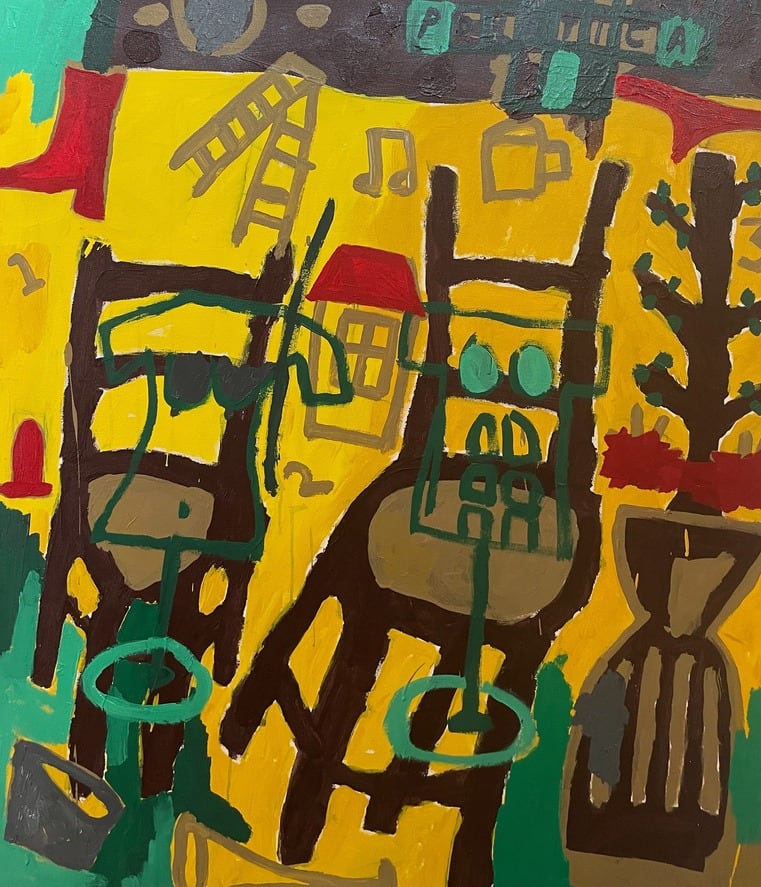
Political Chair
Power in this country is not always earned by winning hearts. Sometimes it is enough to purchase influence, distort the truth, manipulate the rules, and make sure that those who lose never truly have a chance to win.
The government seat becomes a symbol of a game that has lost its shame. Around it, promises of democracy, public service, and the people's interests become convenient languages — produced, traded, and discarded once power has been secured. This work confronts power not as a responsibility, but as a commodity to be fought over. A seemingly ordinary chair becomes a silent archive of transactions, manipulation, purchased loyalty, and compromises deliberately buried beneath the appearance of legitimacy.
Here, corruption is not merely a deviation from the system. It has become part of the way the system functions. The question is no longer who is corrupt, who cheats, or who plays dirty. The more disturbing question is: if the game was designed to be won through dirty hands, who still believes the game was ever fair? The chair remains standing. Power continues to change hands. And the nation is repeatedly asked to believe that everything is working exactly as it should.
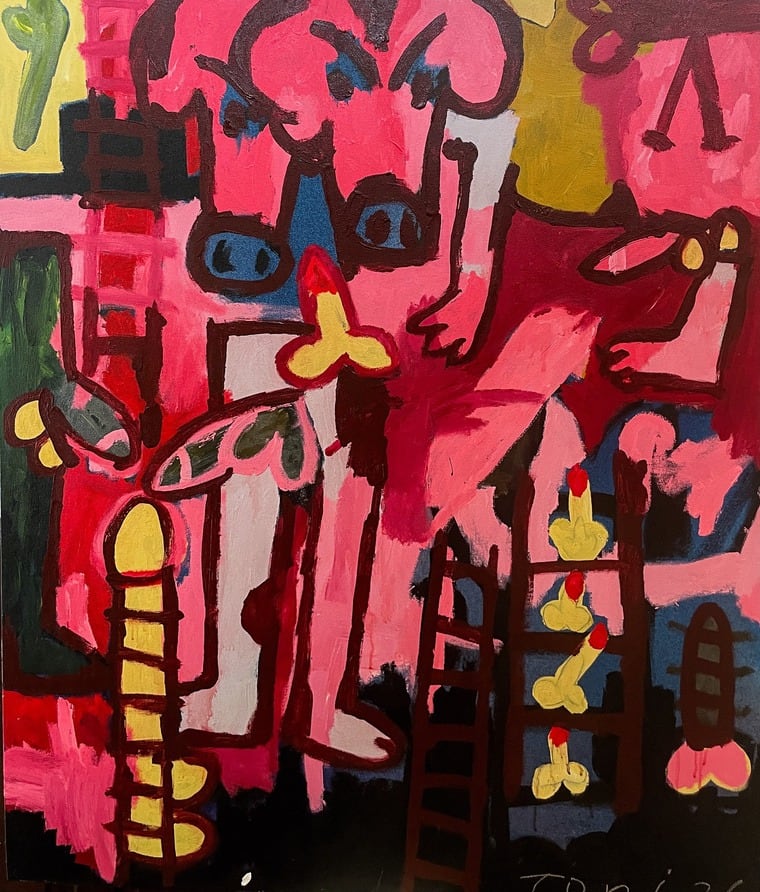
Titit Collection
Began with something deceptively simple: crude drawings of genitalia scribbled on school desks and notebooks — a childish act of mischief, laughter, provocation, and an indirect profanity that existed before it had any political language.
What was once dismissed as a meaningless schoolboy doodle now resonates with a much larger reality. The body, vulgar humour, and seemingly trivial symbols become a language through which power can be confronted: a language of absurdity, frustration, and everyday experience. At the centre of the work, the pig's head becomes a symbol of greed — not the portrait of a particular individual, but an image of the appetite to accumulate, control, and take beyond what is necessary. It exists somewhere between humour and unease, between the innocence of schoolyard mischief and the political realities of contemporary Indonesia.
Titit Collection brings the language of the schoolyard into confrontation with the language of power. A drawing once made for a laugh becomes a small archive of how profanity, the body, and humour can articulate what is difficult to say directly. What was once considered insignificant returns as a sign: crude, absurd, and uncomfortably close to reality.
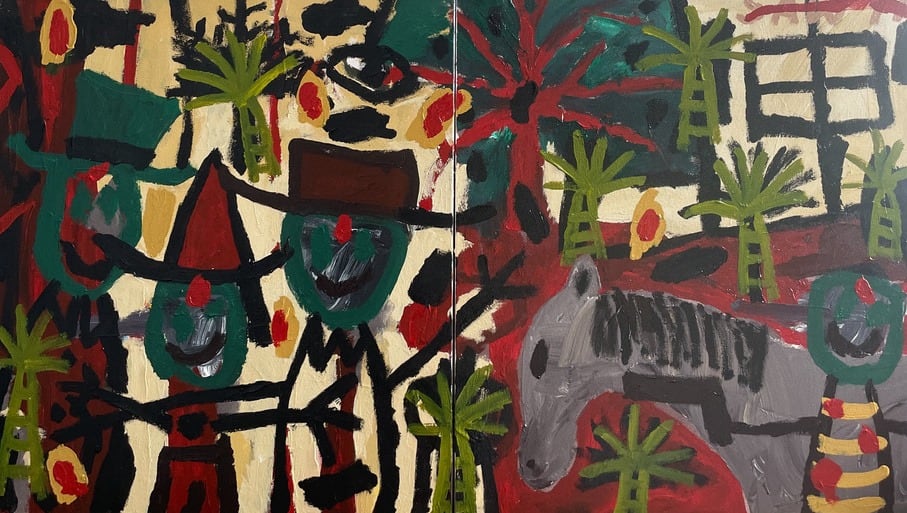
Sawit
Emerges from anger toward the way forests are treated as empty spaces — spaces that can be cleared, converted, and exchanged for profit. The forest is not merely a landscape, but a home to an immense diversity of flora and fauna, gradually displaced in the name of palm oil expansion. When trees fall and habitats disappear, what is lost is not only an ecosystem, but also memory, life, and the right to continue existing.
The work confronts a profound paradox: at a time when Indonesia's economy remains marked by inequality and widespread poverty, development continues to favour the accumulation of capital and the extraction of natural resources. Forests are sacrificed in the name of growth, while prosperity does not necessarily grow alongside the expanding plantations. Sawit also points to the absurdity of contemporary priorities: while poverty persists and basic needs remain unmet, energy, attention, and resources can instead be devoted to maintaining forms of luxury — even horses. This contrast exposes the widening distance between those who possess the power to consume and those left to bear the consequences of economic decisions.
The work is not only about palm oil. It asks who has the authority to decide what must be sacrificed, who is allowed to profit, and who is left behind. Sawit is an expression of anger toward a development logic that turns forests into commodities, life into numbers, and poverty into a background condition simply accepted as normal.
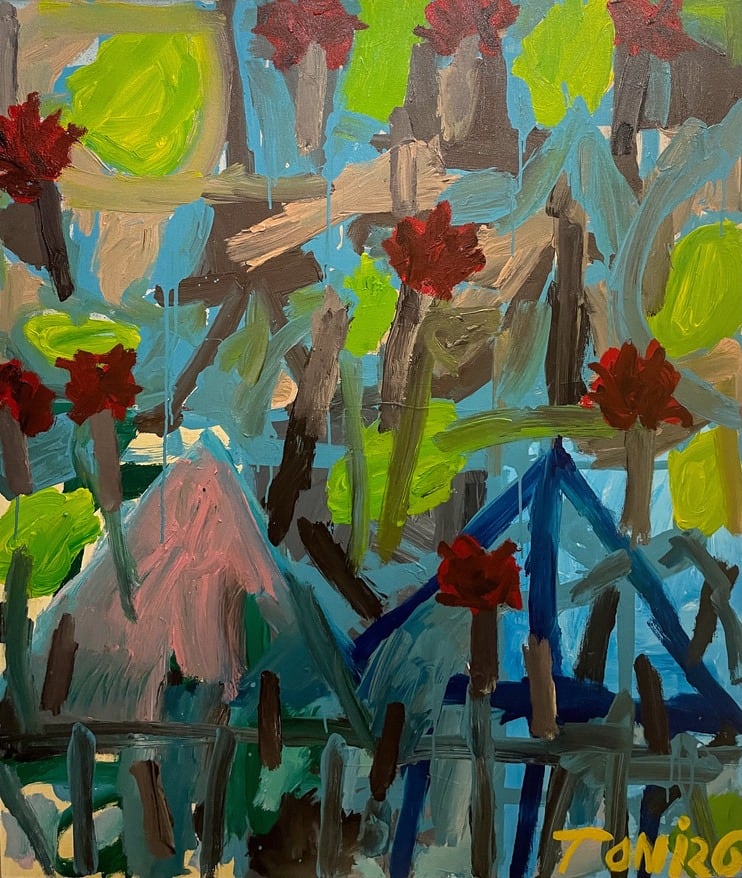
Rainforest
Continues the reflection initiated in Sawit, examining the forest as a profound paradox: something so beautiful, exotic, and valuable that the world desires it, yet precisely because of that value, it is continuously destroyed.
The rainforest is imagined as a form of wealth that should be beyond measure. Its biodiversity, trees, sounds, colours, and countless forms of life constitute something far more complex than a landscape. Yet under an economic logic that assigns a price to everything, the forest is reduced to land — cut down, burned, cleared, and transformed into a site of production for the enrichment of a few. There is an irony in the way tropical forests are perceived as exotic and precious from afar, while in their places of origin they are systematically destroyed. The beauty admired from a distance is built upon processes of erasure occurring much closer to everyday life.
Rainforest questions how something so valuable can be so easily treated as something expendable. It confronts greed, an economy that turns nature into capital, and a system capable of transforming forests — and all the life within them — into figures on a balance sheet. If Sawit emerges from anger toward what has already been cut down, Rainforest moves further by asking: why must something so beautiful be destroyed so that someone else can become richer? The work exists within the tension between beauty and destruction — a critique of a human logic that sees nature not as a form of life with its own value, but as something to be owned, sold, and consumed.

A significant portion of funds raised from this auction piece will be donated to the Borneo Nature Foundation.
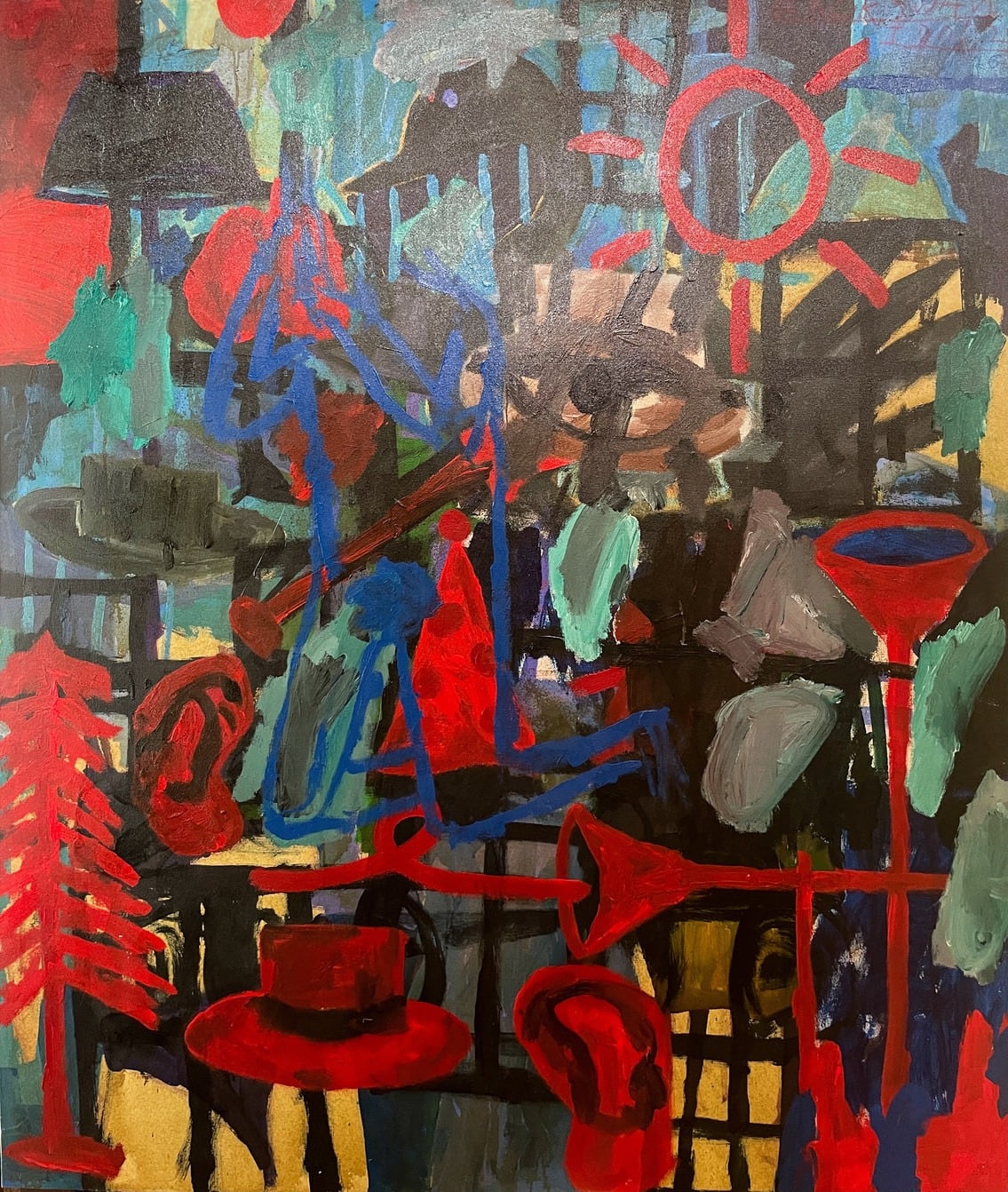
Black Swan
A black swan arrives without warning — not because its existence was impossible, but because the conditions that made its arrival possible were rendered invisible.
Black Swan takes its point of departure from the paradox of the unforeseen: an event that appears improbable before it occurs, becomes undeniable when it does, and is subsequently absorbed into a narrative of inevitability. The work inhabits this temporal fracture between anticipation and aftermath — between what a society claims it could not have known and what, in retrospect, appears to have been everywhere. Within the contemporary Indonesian condition, the black swan is less an extraordinary rupture than a symptom of a system increasingly sustained by rupture itself. Ecological devastation, extractive development, widening inequality, political spectacle, algorithmic acceleration, and the volatility of everyday life are not isolated crises — they are interconnected manifestations of a reality in which instability has become the norm.
Perhaps the most dangerous black swan is not the event we fail to foresee. It is the reality we have already seen, yet continue to call impossible. When floods return, when landscapes disappear beneath development, when ecological thresholds are crossed, when economic precarity becomes inherited, when technological systems reshape public consciousness faster than institutions can respond — at what point does catastrophe cease to be an anomaly and become infrastructure?
Black Swan refuses the comfort of prediction. Instead it turns toward the politics of hindsight: our persistent desire to explain disaster after it has occurred, to locate causes, assign responsibility, and reconstruct a sense of order. In doing so, the work exposes a deeper mechanism — the human tendency to mistake explanation for understanding, and familiarity for control. The black swan becomes a figure of contradiction: beautiful and ominous, singular yet systemic, foreign yet already embedded within the landscape.
The work does not ask what catastrophe might come next. It asks a more unsettling question: what if catastrophe is no longer an interruption to the present, but one of the conditions through which the present is produced? Its tension lies not in the arrival of the unexpected, but in the moment when the unexpected becomes familiar.
Fresh Air
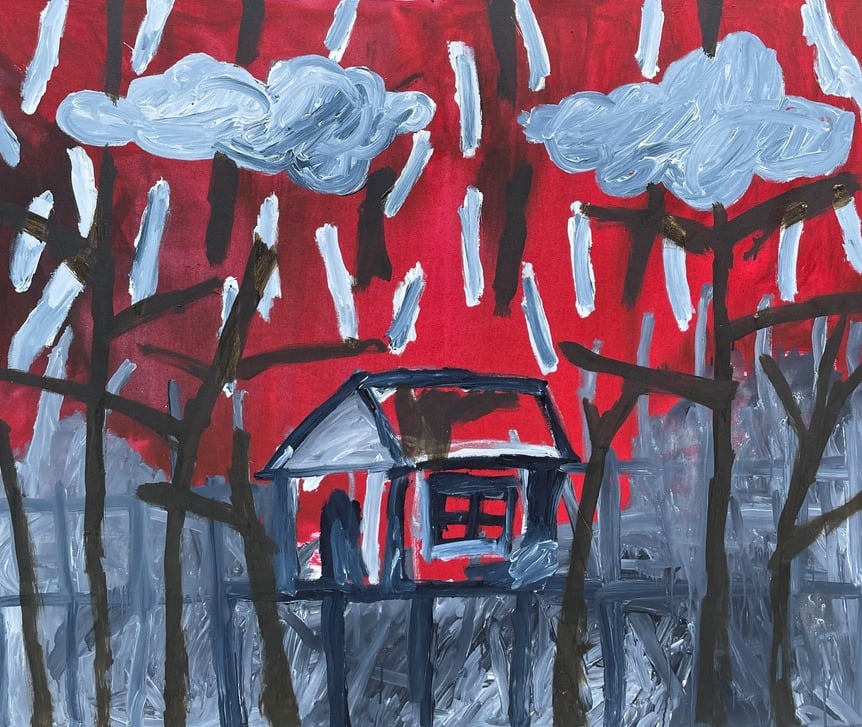
Continues the concerns explored in Sawit and Rainforest, bringing the destruction of forests into the most intimate territory of the human body: the air we breathe.
The work emerges from an imagining of forest and land fires in Kalimantan — forests burning, skies disappearing beneath smoke, and air, something that should be the most basic condition of life, becoming something that must instead be fought for. Smoke does not recognise administrative borders. It moves beyond forests and cities, even across national boundaries, carrying the consequences of ecological destruction far beyond the place where it begins. Amid this, the work raises an unease about how priorities are determined: while forest fires and environmental crises recur, public funds and political attention are simultaneously directed toward government projects that remain subjects of public debate. The critical point is not simply how much money is spent, but what is considered urgent enough to be protected, and what is considered capable of waiting.
Fresh Air does not offer an answer. It places an unsettling question at its centre: does all of this really have to happen this way? Air becomes the simplest — and perhaps most political — metaphor. It cannot belong to a single person, cannot be fenced off, and cannot be negotiated. Yet its quality can be destroyed by decisions made far away from those left to breathe their consequences. If Sawit speaks of forests being cut down, and Rainforest of beauty sacrificed for profit, Fresh Air speaks of what remains after that destruction: polluted air and the question of who is responsible. It is not a request to breathe more easily — it is a demand to ask why we have reached a point where clean air itself has become something we must ask for.
Punch Punch
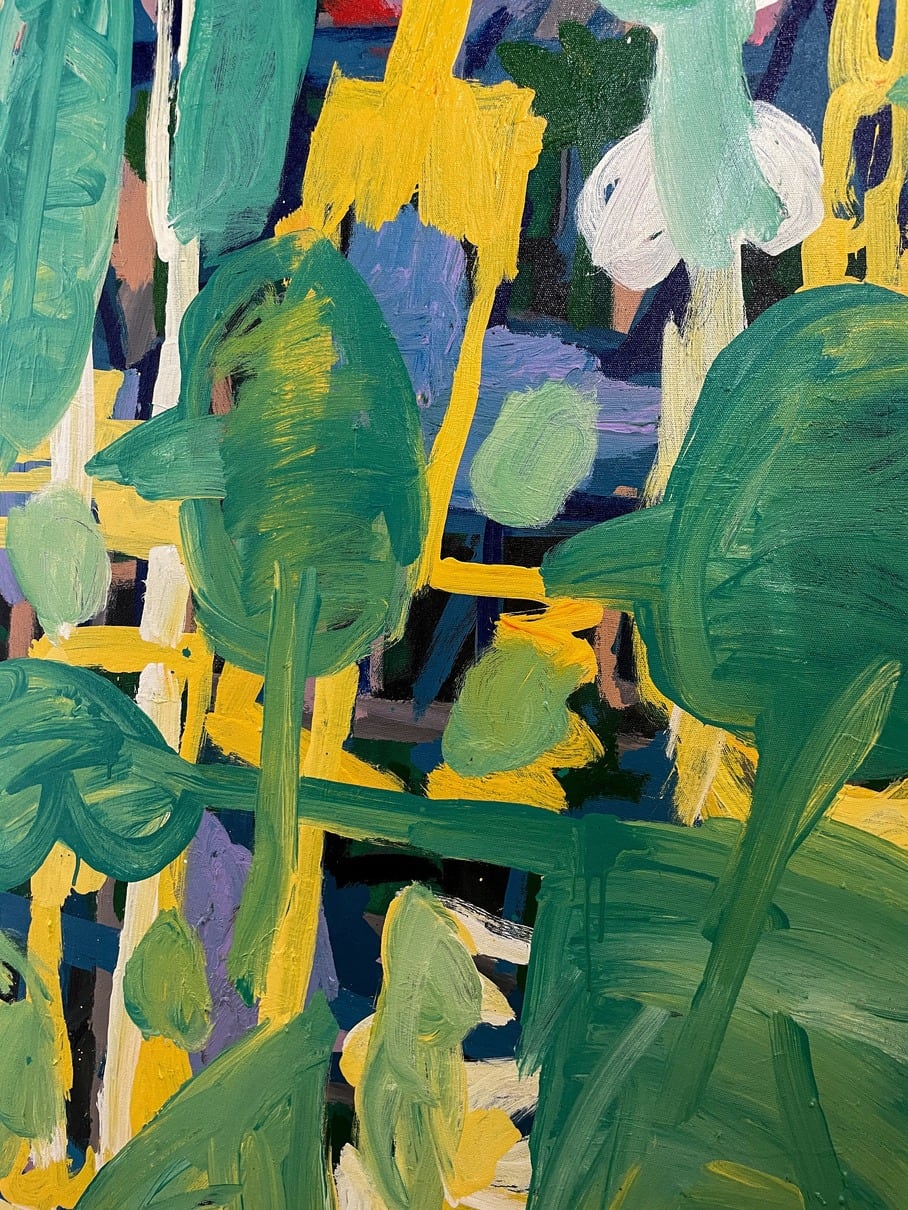
Emerges from an accumulated sense of exhaustion, frustration, and anger toward a system that has been allowed to operate for far too long without clarity or accountability — a system meant to serve society that often becomes something complicated, opaque, and vulnerable to corruption and the abuse of power.
The punch in this work is not merely a physical act, but a gesture of resistance. It represents the impulse to strike, disrupt, and crack open structures that have been treated as untouchable for too long. When rules lose their sense of justice, when accountability becomes negotiable, and when corruption is repeated until it begins to feel normal, silence can no longer be considered neutral. PUNCH PUNCH speaks of anger that has accumulated into energy — a society repeatedly forced to endure uncertainty, to wait for changes that never fully arrive, and to witness the same failures reproduced within the same structures. The punch becomes a language when words are no longer sufficient.
The work asks: how long can a society absorb the blows of a system before it decides to strike back? PUNCH PUNCH is not a call for blind destruction, but a gesture of disruption — an attempt to disturb the comfort of established structures and to insist that no system should be immune to criticism. When a system repeatedly fails to protect the society it is meant to serve, that system must be questioned, shaken, and forced to change.